Top Signs You Need Garage Door Service – Don’t Ignore These
A garage door that takes three seconds longer to open than it did last month isn’t “just getting old” – it’s telling you the springs are losing tension and the opener motor is quietly compensating for the imbalance. That extra strain shortens both lifespans at once. The signs below are the ones homeowners dismiss as minor annoyances right up until the door jams halfway and nobody can leave the driveway. If you’d rather leave the diagnosis to the pros, call (844) 914-3733 and we’ll take a look.
We’re Apple Valley Garage Door Repair Pros, and we work on garage doors every day in Apple Valley, MN. Here’s what we watch for, and what each symptom actually means.
Key Takeaways
- A door that hesitates, drifts, or sounds different is usually signaling a mechanical problem before it becomes a failure.
- The balance test tells you more about spring health than any other two-minute check.
- Specific sounds point to specific parts – grinding, banging, and clicking each have their own causes.
- Small issues compound: a cheap roller swap can turn into a far bigger repair if you wait.
- Anything involving springs and cables is a job for a trained technician, not a weekend project.
Your door hesitates or feels sluggish. What does that mean?
A sluggish door almost always points to an imbalance between the springs and the opener. When the springs are still doing their share, the motor glides the door up with barely any effort. When they’ve lost tension, the motor has to haul the full weight. It still works – for a while – but it’s straining the gears, the belt or chain, and the motor itself.
Picture a door that’s supposed to weigh maybe a couple hundred pounds and suddenly feels a lot heavier to the opener. That’s the exact scenario we find most often in Apple Valley when a homeowner says the door “feels lazy.” The opener isn’t the real problem; it’s just the messenger.
Hesitation can also come from a misaligned track, a roller that’s flat-spotted, or a hinge that’s dried out. But if the door still opens and closes and just seems tired, springs are the first thing a technician checks. This is a garage door spring repair conversation nine times out of ten.
Don’t ignore it because the door still technically works. We see openers burn out faster on doors with failing springs, and openers cost more to replace than most spring jobs. If you’d rather not wait for the motor to give up too, call (844) 914-3733.
How do you test whether your door is balanced?
The balance test is the single most useful check a homeowner can do, and it takes about two minutes. Here’s the safe version – do this with the door closed, standing clear of the moving parts.
- Pull the manual release cord (usually hanging near the opener rail) to disconnect the opener. The door is now only supported by its springs.
- Lift the door slowly by the bottom section to about waist height.
- Let go – carefully, with your hands clear – and watch what happens.
What you want: the door sits still, or drifts an inch or two at most. What it means if it doesn’t:
- It drops toward the floor: the springs aren’t holding enough tension. The door is heavier than the springs can support.
- It rises on its own: the springs are over-tensioned or one is wound differently than the other.
- It jerks or drops suddenly: a spring may be cracked or one side has failed. Stop testing and call us.
A drifting door puts constant uneven stress on the opener, the cables, and the tracks. That’s how a door that “still works” starts chewing through parts. If the door won’t stay put, don’t run the opener on it repeatedly – call us at (844) 914-3733 so a technician can check the springs. A technician can also tell you whether a repair is the right call or whether you’re heading toward garage door repair on a larger scale.
One safety note that matters: never touch, adjust, or try to rewind a torsion spring or cable yourself. They’re under extreme tension and can cause serious injury if they release unexpectedly. That’s why we treat spring work as its own dedicated service – it’s not a general handyman job.
What do the noises actually mean?
Every noise a garage door makes is a clue. We’ve gotten good at translating them, and once you know the language you can catch small problems before they become big ones.
- Grinding or scraping: usually worn rollers or dry hinges. The metal-on-metal contact is the sound of parts that should be lubricated or replaced. Left alone, grinding rollers chew into the track itself.
- A loud bang from above: in almost every case, a torsion spring has snapped. The door will often still lift partway and then feel stuck or fall back. Stop using it and call us.
- Rattling: loose hardware – bolts, hinges, or the track brackets. Often a simple tighten-and-adjust fix.
- Clicking that repeats: on LiftMaster and Chamberlain openers, a repeating click often means a relay on the logic board is failing. The click is the relay trying to engage and dropping back out.
- Squealing: usually a dry bearing or a worn roller. Some of this is normal; a lot of it isn’t.
Here in Apple Valley, the temperature swings between summer and winter are hard on garage door hardware. Metal expands and contracts, lubrication dries out faster, and springs take more of a beating than in a milder climate. It’s why we see plenty of noise-related service calls in the shoulder seasons.
If your door has started talking to you in a language you don’t recognize, we can translate. Call (844) 914-3733.
Why does the door respond differently to the wall button and the remote?
This is a diagnostic detail most people miss. If the door works from the wall button but not the remote – or the range of the remote has shrunk to “practically standing inside the garage” – you’re dealing with two different parts of the system.
- Fails from the wall button too: the problem is likely in the opener itself – the logic board, the motor, or the wiring between the button and the unit.
- Works from the wall button but not the remote: the opener is fine. The issue is the remote, the battery, or the receiver/antenna inside the unit.
- Intermittent from both: often the logic board, a loose connection, or failing capacitors in an older unit.
Newer openers make this trickier, because remote lockouts, safety sensors, and connectivity features all interact. Smart-home-compatible systems from LiftMaster, Chamberlain, and Genie behave differently than the older units, and a technician who knows the brand can usually pinpoint the cause without guesswork. We’re certified to work on the most widely installed opener brands in North America, so diagnosing a Genie versus a Chamberlain versus a Craftsman isn’t a learning curve for us.
If you’re chasing a remote that only works when the car is parked at the right angle, that’s a garage door opener repair worth scheduling before the opener quits entirely. Call (844) 914-3733 to get it looked at.
What should you check visually from the ground?
You don’t need to climb a ladder to spot trouble. Cable fraying and roller wear are visible from the ground if you know what you’re looking for. Give yourself a couple of minutes and look at these:
- Cables: check the drum area and along the sides. Frayed strands, kinks, or a cable that looks like it’s slackening on one side are all warning signs. Never touch a frayed cable – call a technician.
- Rollers: look at where the rollers travel in the track. Worn rollers can look flattened, chipped, or shiny where they’ve worn through. Nylon rollers often develop flat spots; steel rollers can develop a grinding edge.
- Tracks: they should be straight and evenly spaced. Dents, kinks, or gaps suggest impact damage – common when a car clips the door or a track gets pushed out of alignment.
- Hinges and panels: look for rust streaks, misalignment between panels, or hinges that look loose. A gap between panels usually means something structural has shifted.
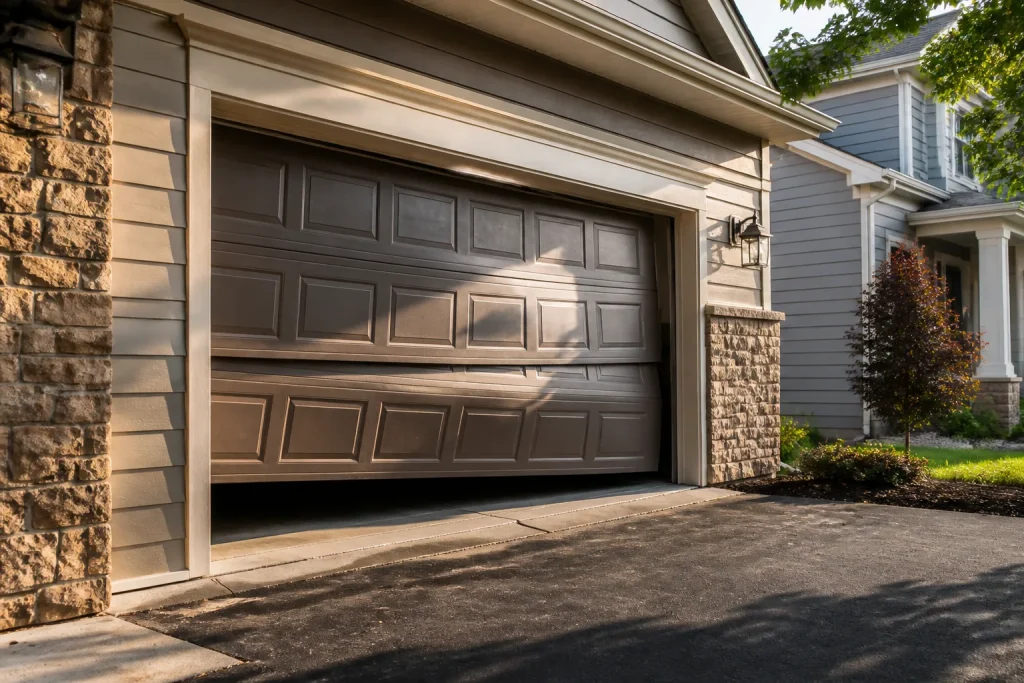
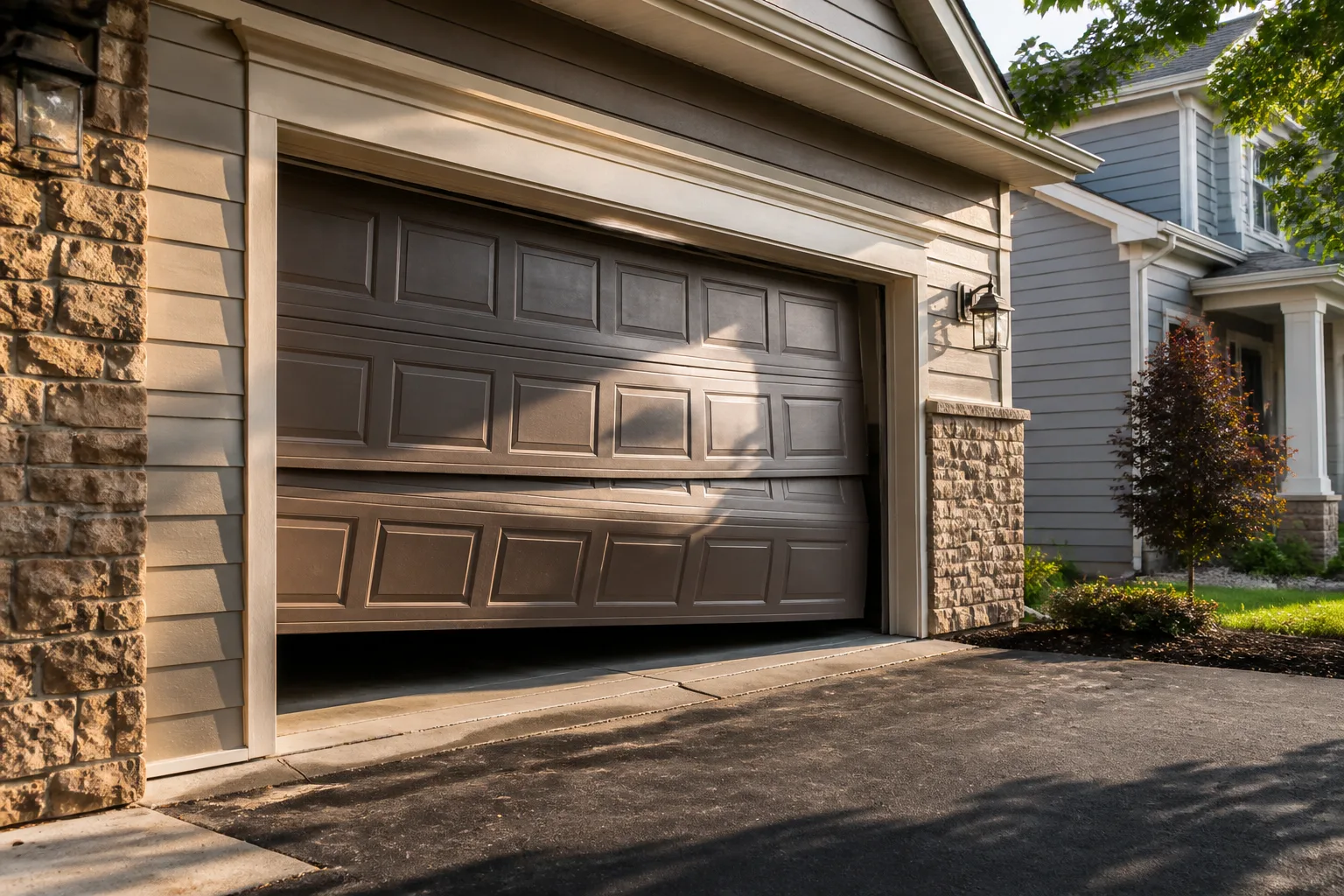
- The door itself: if the panels look uneven or the door closes crooked, treat it as a balance issue until proven otherwise.
A quick walk-around in Apple Valley after a windstorm or a hard freeze can catch small issues early. It’s also worth doing before the heavy use months set in.
If you see anything that looks off – especially a cable that’s starting to fray – stop using the door and give us a call at (844) 914-3733.
Why does waiting cost more?
This is the argument that gets dismissed the most: “It still works, why fix it?” Because every skipped repair tends to escalate into a bigger one.
Think of it as a chain reaction. A worn roller costs a modest amount to replace. Ignored, that worn roller grinds against the track and eats into it, and now you’re looking at track damage on top of the roller. A dry hinge leads to a sagging door section, which leads to misaligned panels. A failing spring keeps loading the opener, and eventually the opener’s gear or motor gives out. The cheap fix never gets cheaper by waiting.
What starts as a small roller-and-hinge job can quietly turn into a cable, track, and panel repair – which is why we always tell homeowners to fix the cheap thing while it’s still cheap.
We see plenty of Apple Valley homes where a postponed repair ended up costing more than the original problem. If you’ve been putting off “the little noise,” this is your reminder: call (844) 914-3733 and get a free estimate before the small problem finds its own timing.
What if the door fails entirely?
Sometimes a door doesn’t give you a warning. It just stops, and it stops at a bad moment – late at night, before the morning commute, or the day before company arrives. That’s where a service like ours comes in. Emergency garage door service exists for the situations where security or access can’t wait for a scheduled appointment.
If your door won’t open, won’t close, or has come off its track, don’t force it. Forcing a stuck door often bends panels or damages the opener further. Disconnect the opener with the manual release (so it doesn’t fight you), leave the door where it is, and call us at (844) 914-3733.
When should you call a pro instead of handling it yourself?
Some garage door fixes are genuinely simple – a battery change in the remote, a loose bolt, a bit of lubrication on a squeaky hinge. Others are dangerous, and a homeowner shouldn’t take them on.
Call a trained professional when:
- Any spring is involved – torsion or extension. These are under extreme tension and can cause serious injury.
- A cable is frayed, loose, or has snapped. Never handle a tensioned cable.
- The door is off its track, leaning, or comes down unevenly.
- The opener runs but the door doesn’t move, or the motor sounds like it’s straining.
- You’ve tested the balance and the door drops or rises on its own.
If you’re in Apple Valley and not sure which category a symptom falls into, we’re happy to tell you on the phone whether it’s a quick fix or a real repair. Our technicians have up to 9 years of experience, and we’re certified to work on 8 of the most widely installed garage door and opener brands in North America – LiftMaster, Chamberlain, Genie, Clopay, Amarr, Wayne Dalton, Craftsman, and Raynor – so bringing in the right knowledge for your brand isn’t the hard part. And we quote and agree on the price before any work starts, so there are no surprises when the job is finished.
Related services in Apple Valley: if you’re already seeing a sign, you can jump straight to garage door spring repair or garage door opener repair for more detail – or head back to our main page to see the full range of what we do.
The Bottom Line
Garage door problems rarely appear out of nowhere. They give you signs first: a door that hesitates, a sound that wasn’t there last month, a remote that only works up close, a wobble in the balance test, or a roller that’s started grinding. The trick is to act on those signs while they’re still small – because the difference between a modest roller replacement and a bigger repair is usually just timing.
We’re Apple Valley Garage Door Repair Pros, and we handle everything from repair and spring work to opener service and full installation. If you’re in Apple Valley and need help, Apple Valley Garage Door Repair Pros offers free estimates – call (844) 914-3733.
Frequently Asked Questions
The earliest signs are usually a door that opens slower than it used to, a new grinding or squealing noise, a remote that only works up close, or a door that drifts in the balance test. Any one of those is a good reason to have a technician take a look before it turns into a bigger repair. Call (844) 914-3733 for a free estimate.
A broken torsion spring usually makes a loud bang and leaves the door feeling extremely heavy – often too heavy to lift, or lifting partway and stopping. You may also see a gap in the spring above the door. A broken extension spring will look visibly stretched out or separated along the side. Don’t try to test or move the door further if you suspect a broken spring. Call (844) 914-3733 instead.
Grinding itself usually isn’t an emergency, but it’s not something to ignore. It typically means worn rollers or dry hinges, and if left alone, worn rollers can damage the track. The bigger safety concern is what the noise is hiding – a door under stress can progress to a spring or cable failure. Call (844) 914-3733 and we’ll identify the source.
Replacing a roller sounds easy, but it means working on a door that’s under spring tension, and doing it wrong can cause the door to come off its track or drop unpredictably. We recommend leaving roller replacements to a trained technician. A technician can swap the roller and check the surrounding hardware at the same time. Call (844) 914-3733 for a free estimate.
No. We quote and agree on the price before any work starts, and the written estimate is the price. If the job requires more than originally expected, we’ll talk it over with you first – nothing gets added without your go-ahead. Call (844) 914-3733 for a free estimate.
Written by the team at Apple Valley Garage Door Repair Pros.
Need Garage Door Help?
Call Apple Valley Garage Door Repair Pros - the local pro we connect you with is licensed and insured, here with fast after-hours help in Apple Valley.
(844) 914-3733